
Crowding

What is Dental Crowding?
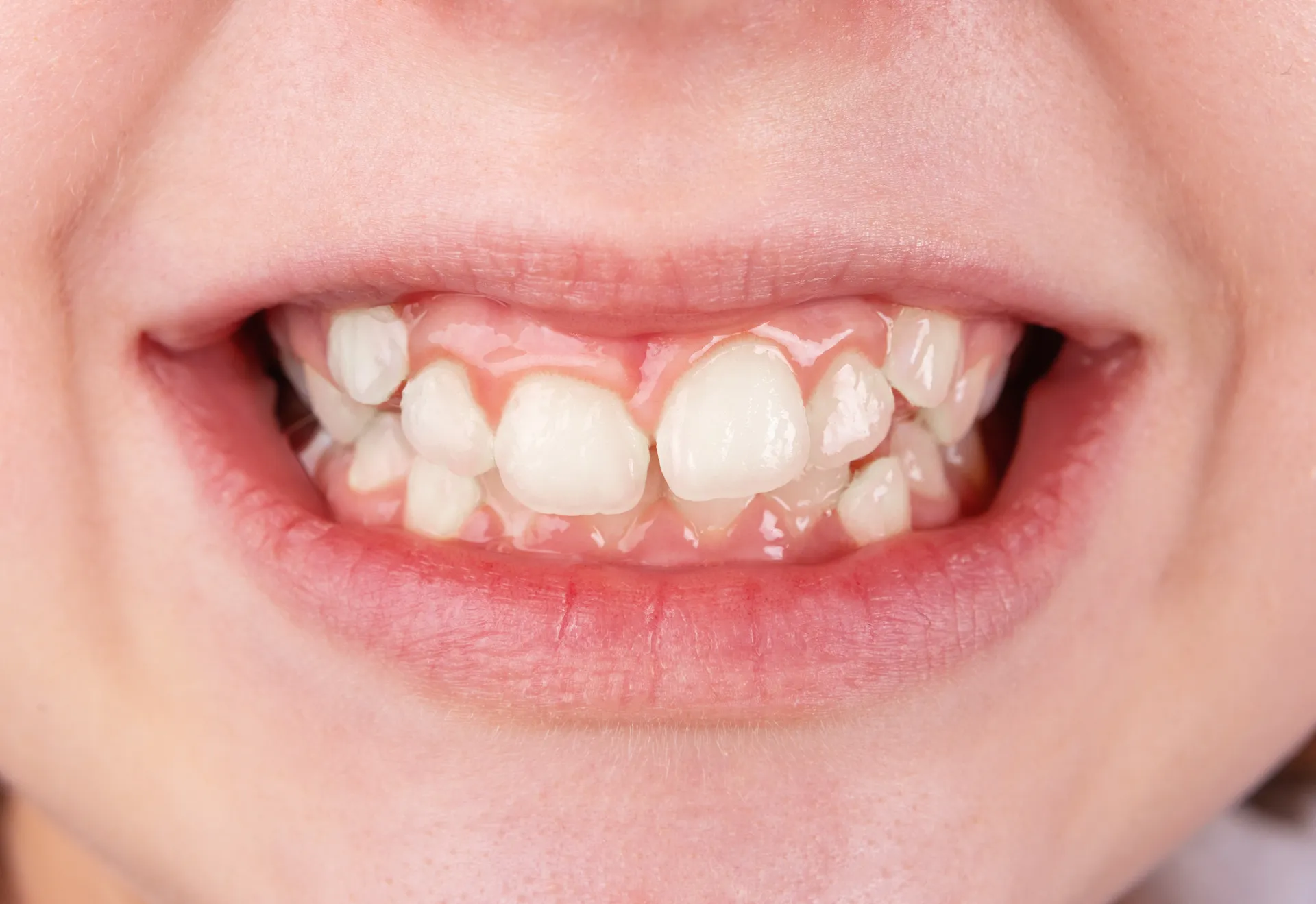
Dental crowding is a type of malocclusion (bite problem) that happens when there isn't enough room in the jaw for all the teeth to fit in line, so they overlap, twist or are pushed out of position. It's one of the most common orthodontic problems, ranging from a single overlapping tooth to a full mouth of teeth competing for space.
Crowding is usually caused by a mismatch between the size of the teeth and the size of the jaw — either teeth that are larger than average or a jaw that's too small to fit them — and can also follow the early loss of baby teeth. As well as affecting the look of a smile, crowded teeth are harder to clean thoroughly, which can raise the risk of tooth decay and gum disease over time.
Crowding responds very well to orthodontic treatment. Depending on the severity, crowded teeth can be straightened with braces or clear aligners like Invisalign — sometimes by gently widening the arch to create space, and occasionally by removing one or more teeth in more severe cases — bringing everything into a neat, well-aligned position that's easier to keep clean. Our specialist orthodontists in Dublin can assess your teeth and recommend the best treatment. Book Consultation to get started.
FAQs
A mismatch between the size of the teeth and the size of the jaw. If the teeth are larger than the arch can hold, they overlap, rotate or get pushed out of line. Both tooth size and jaw size are largely inherited.
It is not caused by anything you did, and it is not a sign of poor dental care. More on our crowding page.
Space has to come from somewhere, and there are three sources: expanding the arch slightly, reducing the width of teeth by a fraction of a millimetre each where appropriate, or removing teeth where the shortage is severe.
Which applies depends on how much space is missing and on your facial profile. Mild crowding is often straightforward with clear aligners. Severe crowding, and anything involving extractions, is usually better handled with fixed braces, which give more control over root position.
Frequently, yes. Mild and moderate crowding is usually treated without removing anything, by widening the arch a little and by interproximal reduction, which shaves a fraction of a millimetre from the sides of teeth to create room.
Extractions come in where the shortage is severe, or where taking teeth out gives a better facial result than pushing the front teeth forward. We do not extract as a matter of routine, and we will explain the reasoning if we recommend it.
Orthodontists measure it as the difference between the space available and the space the teeth need. Roughly speaking, a shortage of a couple of millimetres is mild, up to about four is moderate, and beyond that is severe.
What matters more than the label is what it takes to fix. Severe crowding is the category where extractions become likely, and where fixed braces generally outperform aligners.
Yes, particularly the lower front teeth, and it happens to people who had braces as well as those who never did. This is normal age change rather than anything going wrong.
It is the reason retainers are a long-term commitment, and the reason waiting to see whether crowding settles down on its own is not a strategy that works.
Usually it does not feel like anything, which is part of the problem. Crowding is normally noticed visually rather than through discomfort.
What people do notice is practical: floss shredding or refusing to pass between certain teeth, food catching in the same spot, a tooth that feels like it sits proud of the others, or particular teeth that are always harder to brush and stain more quickly.
It depends entirely on which one. Mild crowding or spacing may cause nothing worse than teeth that are harder to clean. A deep bite, a crossbite or a large overjet are different, because each causes progressive damage: enamel wear, gum recession, or a jaw habitually displaced to one side.
The honest answer is that some bite problems are worth living with and some are not, and only an examination will tell you which you have. There is more on our problems we treat page.

Book a Consultation
Discuss your goals with one of our specialist orthodontists to find out what treatment option suits you best.
Begin Your Journey
Thinking about it? Book your first consultation and come see us — we'll take it from there.