
Braces (Train Tracks)Dundrum

Fixed braces in Dundrum
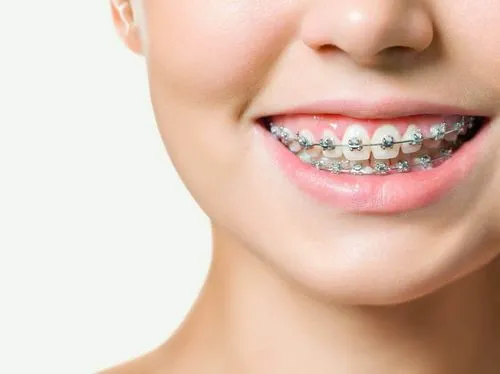
Brackets bonded to each tooth, joined by a wire. The wire is what moves the teeth, and it remains the most versatile appliance in orthodontics.
Where teeth are severely rotated, badly crowded, or need moving bodily through bone, fixed braces do it more predictably than aligners and often more quickly. For complex cases they usually give the better final result.
What to expect
Fitting takes about an hour. Adjustments every six to eight weeks at our Ballinteer Road clinic, twenty minutes or so. Most treatments run eighteen months to two years. Ceramic brackets are available if the look of metal is a concern.
The trade-off is cleaning. Plaque sitting against enamel around a bracket marks the tooth permanently, so brushing properly is not optional.
More on our fixed braces page, or book a consultation.
Parking & Public Transport
The clinic is at 11 The Gables on Ballinteer Road, a few minutes from Dundrum village. The Luas Green Line stops at Dundrum and Balally, and Dublin Bus routes 14 and 74 serve the village.
For drivers, the Dundrum Town Centre car park is a short distance away. Full directions and parking details are on our location and parking page.
Useful Links
Contact Us

The Process

This appointment is really about talking through your goals with one of our orthodontists. We'll likely also go over your dental and medical history, take a look at your teeth and jaw, and depending on what's needed, that might mean X-rays or impressions of your teeth to make models.

From there, the orthodontist looks over the X-rays, photos, and examination findings and puts together a plan specific to you — how your teeth need to move to get where they should be. You'll come away with an idea of how long treatment will take, what it'll cost, and whether any prep work needs to happen first.
.svg)
That might mean a dental cleaning, sorting out any cavities or other issues first, or in some cases extracting a tooth or two to make room for things to shift. Once that's all sorted, you're ready to move on to the next phase.

The orthodontist attaches small bumps to your teeth that help the aligners grip properly, then hands over your first set. We'll check the fit there and then, and walk you through everything you need to know to get started.

You'll come in for progress checks fairly regularly — usually every 8 to 10 weeks — where the orthodontist checks how the aligners are fitting and lets you know if it's time to order the next set.

Taking everything off is usually the easy part — the attachments and wires come out, any leftover adhesive gets cleaned away, and it's over quickly with little to no discomfort.

Once your braces come off, a retainer is what keeps your teeth from drifting back. Most patients wear one full time for a while, then switch to nights only — that's what keeps everything holding in place long-term. Read more here.

Read what our patients say about us
"I went to so many dentists about my bite problem only to be dismissed. Dr Adriana and her team gave me a plan, I followed it, and two and a half years later I can smile, eat and bite properly."

"Two of my daughters had braces fitted by the lovely Dr. Katherine Condren. I would highly recommend her services, she was so good with my daughters, we are extremely happy with the service received and they both have beautiful smiles now."
"My bonded retainer came loose and several other practices turned me away. Dundrum Orthodontics saw me straight away and had it fixed within minutes."
"Dr Joseph O’Connor is such a skilled orthodontist. His kindness and attention to detail is outstanding. He takes the time to explain everything and makes you feel very comfortable. Could not recommend him more."
"I got Invisalign here in my forties and could not be happier. My daughter had braces with them a few years ago, and my sister brought her daughter on my recommendation. Exceptional service and amazing results."
"Joseph is a kind, compassionate and skilled orthodontist. He has a beautiful patient manner and his attention to detail is second to none. Highly recommend."
"Coming to the end of my braces and I couldn't be happier. The whole team are friendly and professional, and they take their time to make sure the end result is exactly what you want."
"I had a great experience with Dr O’Connor and his team. Booking was simple and they were very friendly & efficient throughout. Would highly recommended."
"My son got his braces off this morning and I am delighted with the result. Over two years, any worries we had were sorted and every question answered, always with a friendly and professional approach."
"Amazing service, highly professional. Dr O'Connor was really kind and knowledgeable. Would highly recommend!"
"Dr O'Connor is a brilliant orthodontist, the consultation was thorough and he's easy to talk to."
"Extremely happy with the outcome after braces, great attention to detail! Highly recommend."
"A long and difficult process was made easy by their care and attention. The attention to detail and professionalism was second to none."
"The staff are extremely skilled as well as friendly and easy to talk to. I am very happy with my results and with how the whole process was handled."

Book a Consultation
Discuss your goals with one of our specialist orthodontists to find out what treatment option suits you best.
FAQs
Fees vary widely between practices and between cases, so any figure quoted online is a guess until someone has looked in your mouth.
What moves the number is the complexity of the case, the appliance chosen, whether both arches are treated and how long it takes. Metal fixed braces are generally the most affordable route to a corrected bite. Ceramic braces and clear aligners sit above them.
We give you a firm written figure at your consultation at our Ballinteer Road clinic, with nothing added later.
Twice a day at minimum, ideally after every meal, and give it a proper two minutes.
Angle the brush to clean above and below each bracket separately rather than sweeping across the middle, and follow the gum line all the way round. Interdental brushes get under the wire and between the teeth where a normal brush cannot reach. A water flosser helps but does not replace brushing.
This is the part that decides whether you finish with clean teeth or permanent white marks. Our hygienist will go through it with you if it is slipping.
Not in the way people fear. Fitting braces is not painful at all, since nothing is being drilled or injected.
What you get afterwards is tenderness, starting a few hours later and lasting three or four days. Teeth feel bruised and biting into anything firm is uncomfortable. The same happens more briefly after each adjustment.
Soft food and ordinary painkillers deal with it. It settles, and it does not come back in the same way later in treatment.
For most people, yes, though the reasons are worth being honest about.
The health case is real: straighter teeth are easier to clean over decades, and a corrected bite spreads chewing forces evenly instead of wearing particular teeth. Where there is a deep bite, a crossbite or a large overjet, treatment prevents damage that would otherwise accumulate.
Where teeth are mildly irregular and the bite is sound, it is a cosmetic decision, and that is a perfectly legitimate reason too. We will tell you which of those situations you are in.
Sometimes, subtly, and usually for the better. The clearest changes come where the front teeth were markedly protruding or the bite was deep, because lip support and profile shift as those are corrected.
Where extractions are part of the plan, the profile can flatten slightly, and that is something we consider deliberately rather than by accident.
What braces do not do is reshape the jawbone or sharpen a jawline. Anything claiming otherwise is overselling. Real skeletal change requires surgery or, in children, appliances that influence growth.
Begin Your Journey
Thinking about it? Book your first consultation and come see us — we'll take it from there.